Santander City Council and IHCantabria collaborate in improving the Coastal Flood Emergency Plan
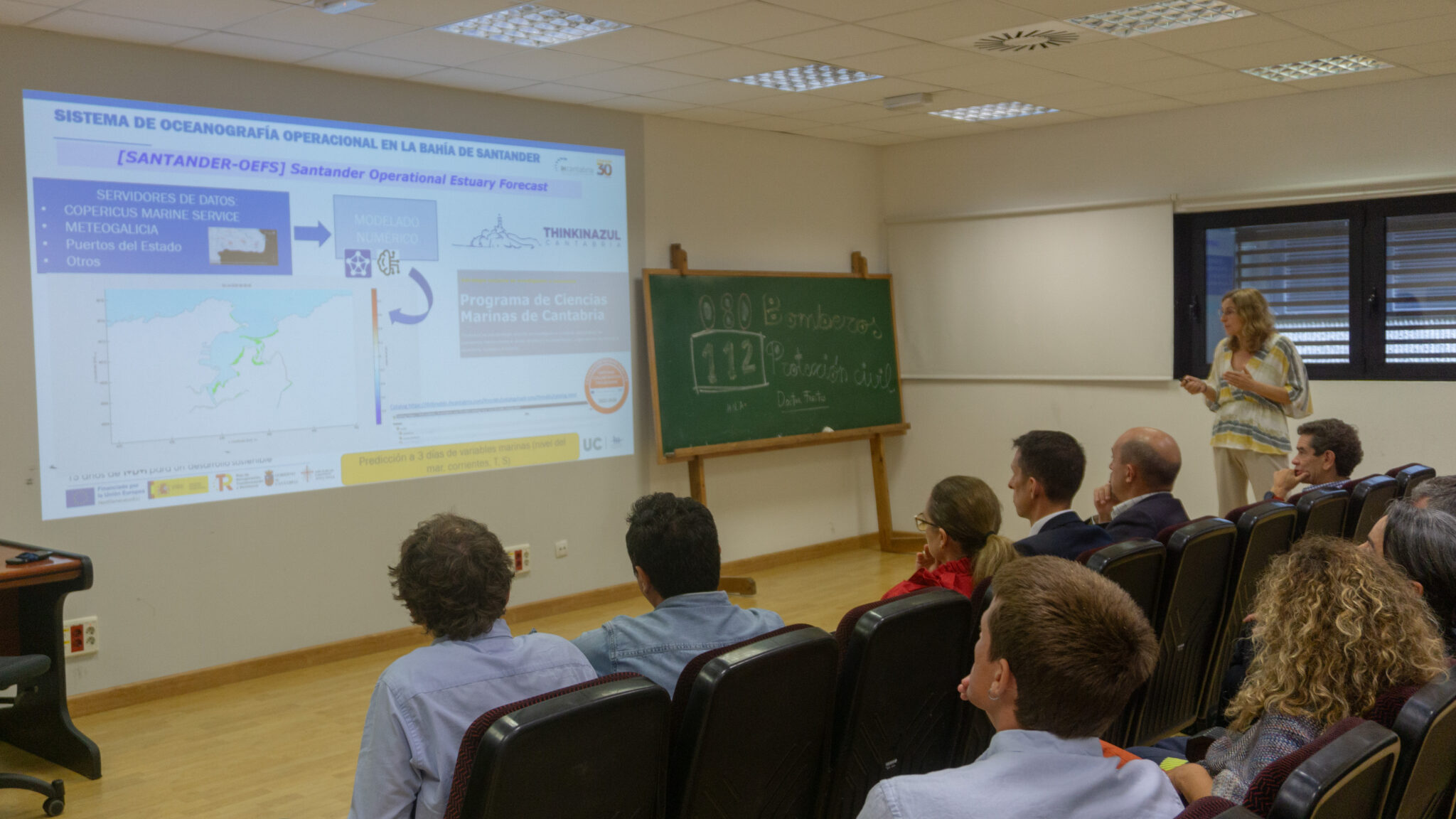
At a technical workshop, the action protocol was reviewed and an Early Warning System was proposed, which provides an action flowchart and visual simulations of the impact of the emergency, to facilitate monitoring and decision making by those responsible for its management
Within the framework of the “Cantabria Smart Litoral” (CSL) Project for sustainable blue tourism, the City Council of Santander and the Environmental Hydraulics Institute of the Universidad de Cantabria (IHCantabria) held a technical conference dedicated to the review of a proposal for improving the protocol for action and communication in the event of coastal flooding.
Based on the forecasts of the Puertos del Estado data network, the proposal includes, as a novelty, an Early Warning System (EWS) based on the prediction of a flood alert, detected 72 hours in advance. Based on operational models developed by IHCantabria, the EWS provides visual simulations of the impact of the emergency, facilitating the monitoring and decision making of those responsible for its management.
Relevance of the Early Warning System
Coastal flooding addresses those caused by the effect of strong waves and variations in sea level, resulting from the combination of the astronomical tide, especially during the neap tide season, and atmospheric conditions, such as pressure, winds and storms. As a relevant case, the Santander City Council highlighted the flooding that affected the areas near the Sardinero beaches in 2014.
Both the adaptation of the Emergency Plan protocol (PEMUSAN) and the SAT alert system are in the development phase, with proofs of concept being carried out to validate their technical feasibility. With its implementation, the Santander City Council will have a predictive management tool that will optimize the emergency response, increase the safety of citizens, reduce the risk and economic impact of damage.
With this collaborative initiative, Santander reaffirms its leadership in digitalization and its firm commitment to technological development. This project reinforces the innovative management of coastal risks, will position the City Council of this city as a national reference in the protection of the coastline and the safety of citizens due to natural coastal risks.
The technical conference, which took place on September 19 at the headquarters of the Santander Fire Station, brought together institutional representatives, municipal technicians and experts in risk and emergency management from the Santander City Council and IHCantabria. Among those attending the event were, on behalf of the Santander City Council: Eduardo Castillo, Councilor for Citizen Protection; Álvaro Lavín, Councilor for Innovation; Margarita Rojo, Councilor for the Environment, and Verónica Gutiérrez, Director General for Innovation. On behalf of IHCantabria, Ignacio Aguirre Ayerbe, Gabriel Díaz Hernández and Ana Julia Abascal Santillana participated in this event as principal investigators of some of the projects developed by this Institute.
The Cantabria Smart Litoral Project
Cantabria Smart Litoral(CSL) is a collaborative technology transfer project developed by IHCantabria to provide disruptive solutions to technological challenges of sustainable blue tourism in the Bay of Santander. The project is carried out within the framework of the Complementary Plan for R+D+i in Marine Sciences(ThinkinAzul), with funding from the Ministry of Science, Innovation and Universities, and the Government of Cantabria; it also has the collaboration of Spanish technology companies and government entities that have been making synergies to meet the technological needs of users in the tourism sector.
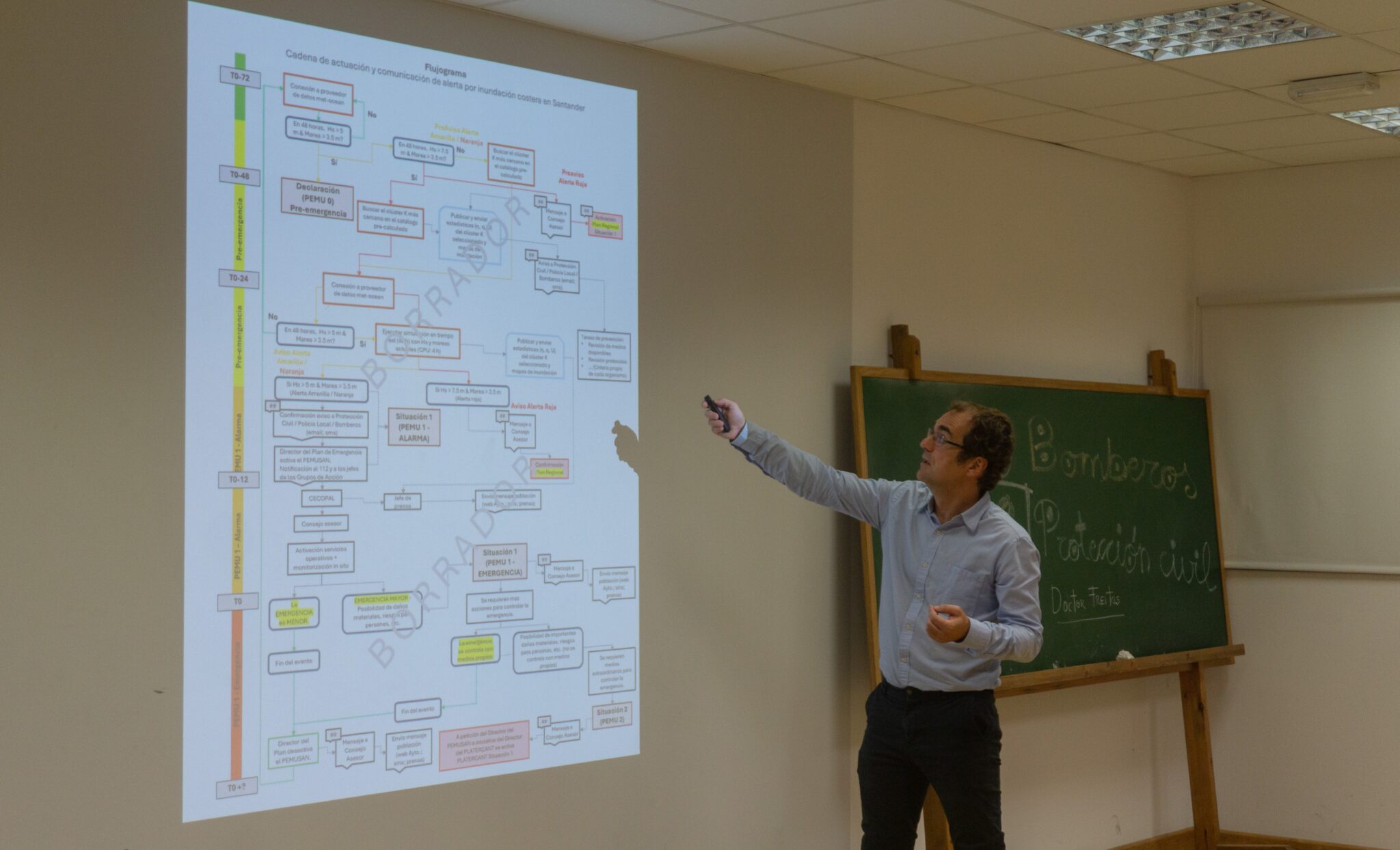
Presentation of the flowchart of the Early Warning System presented at this technical seminar