
Physical Model Testing Begins on the Mutriku Wave Energy Plant: A Strategic Milestone for the MAR+ Project
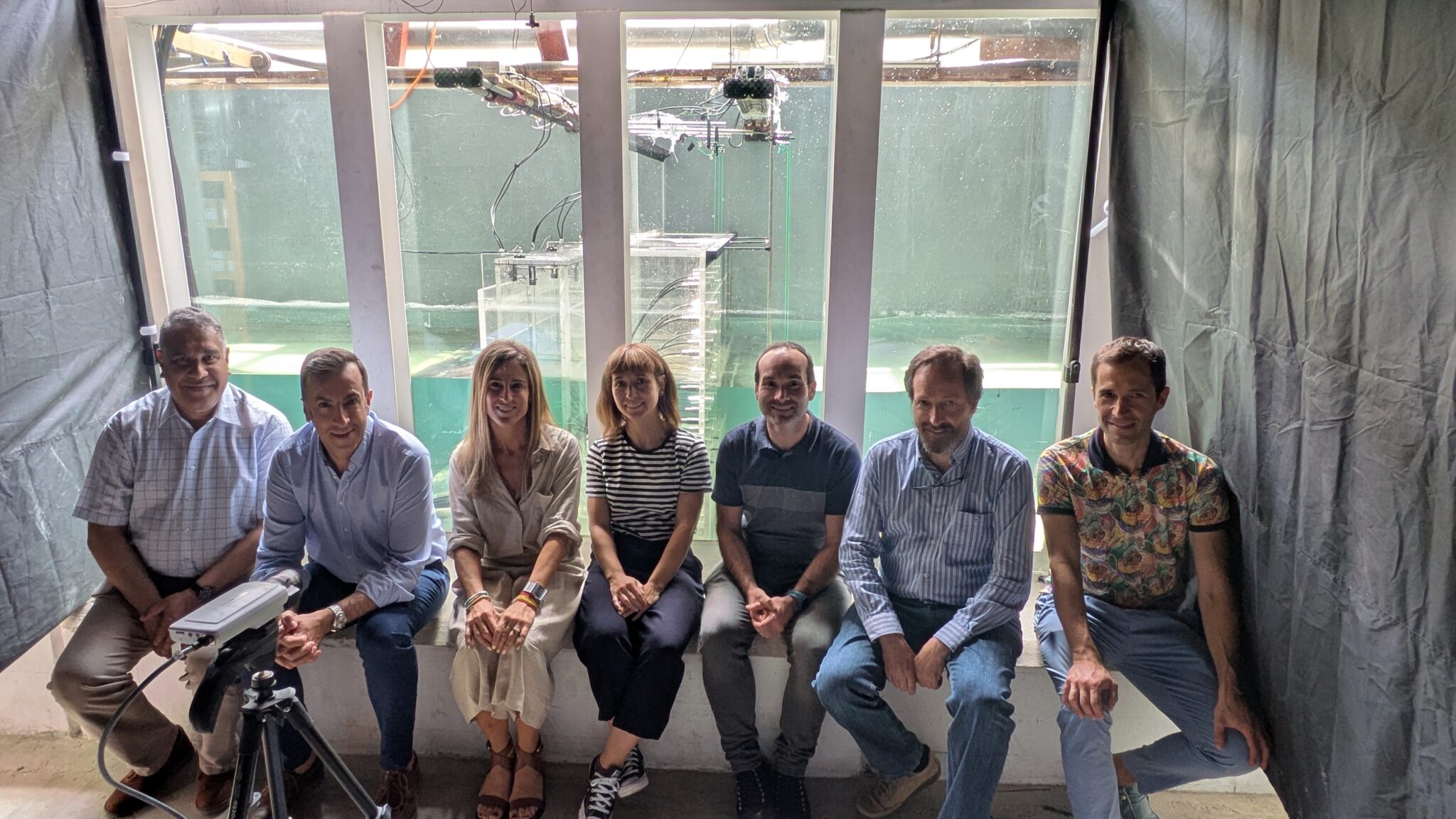
Representatives of the IHCantabria technical team (Raúl Guanche, Cristina Casal, and David Blanco), of the BiMEP partner (Laura Zubiate, Jon Lekube, Yago Torre-Enciso) and of Lloyd’s Register as certifying entity (Winston D’Souza)
The tests will be carried out on a 1:13 scale replica, in the channel of the ‘ETS de Caminos, Canales y Puertos de la Universidad de Cantabria’. They will validate the BUFOWC digital twin and consolidate a wave power device testing methodology endorsed by third parties
The Environmental Hydraulics Institute of the Universidad de Cantabria (IHCantabria) has launched a new physical model testing campaign of the Mutriku wave energy plant —the first grid-connected commercial wave power plant in Europe since its commissioning in 2011. This initiative marks a major strategic milestone within the MAR+ project, which aims to build a world-class knowledge ecosystem for the multiscale testing and validation of marine renewable energy technologies.
High-Fidelity Laboratory Testing for Wave Energy Technologies
The tests are being carried out in the wave flume of the School of Civil Engineering at the University of Cantabria, using a 1:13 scale model of a section of the Mutriku breakwater equipped with 4 of the 16 Oscillating Water Column (OWC) chambers. The model, built in methacrylate and outfitted with over 40 pressure and level sensors, precisely replicates real environmental conditions. This enables in-depth analysis of the air–water–structure interactions and provides a highly accurate platform to study the hydrodynamics of OWCs and the performance of the energy conversion system (Power Take-Off, PTO), with minimal scale effects.
Experimental Benchmarking and Digital Twin Validation
The core objective of this campaign is to generate an open-access experimental dataset that supports the development of PTOs tailored for the Mutriku plant. This data will also facilitate the validation of advanced numerical models such as the BUFOWC digital twin, developed by IHCantabria, enabling simulation and performance prediction of the plant under varied conditions.
The experimental campaign adheres to international standard IEC TS 62600-103, reinforcing IHCantabria’s commitment to industry-aligned practices. Independent oversight is provided by Lloyd’s Register, whose validation of the methodology ensures transparency and technical robustness, strengthening IHCantabria’s position as a trusted center for third-party validation.
Innovative Collaboration in PTO Control Strategies
In collaboration with Mondragon University, the team is also testing a novel method for simulating PTO pneumatic behavior in the laboratory, including control strategies. A fully monitored, remotely operated system has been integrated into the setup to realistically reproduce pneumatic dynamics with minimal scale distortion—paving the way for optimizing control strategies in OWC systems.
Strategic Alliance and Global Leadership
MAR+ is the latest chapter in the long-standing collaboration between BiMEP and IHCantabria, which began in 2014 with the TRL+ project and has continued through initiatives such as EuropeWave and TurboWave. This partnership has resulted in a robust, multiscale scientific and technical offering for the testing of marine energy converters, positioning both institutions as international leaders in offshore renewable technology validation.
With MAR+, IHCantabria and BiMEP strengthens its strategic vision: accelerating the integration of marine renewable energies through cutting-edge scientific research, lab and open-sea testing methodologies, and a global network of collaborators—all focused on sustainable ocean development.

Project CPP2021-009079 funded by MICIU/AEI
/10.13039/501100011033 and by the European Union NextGenerationEU/ PRTR