IHCantabria participates in the launch of the BLUESHORES project, which promotes the adoption of hybrid solutions to protect urban coastal areas.
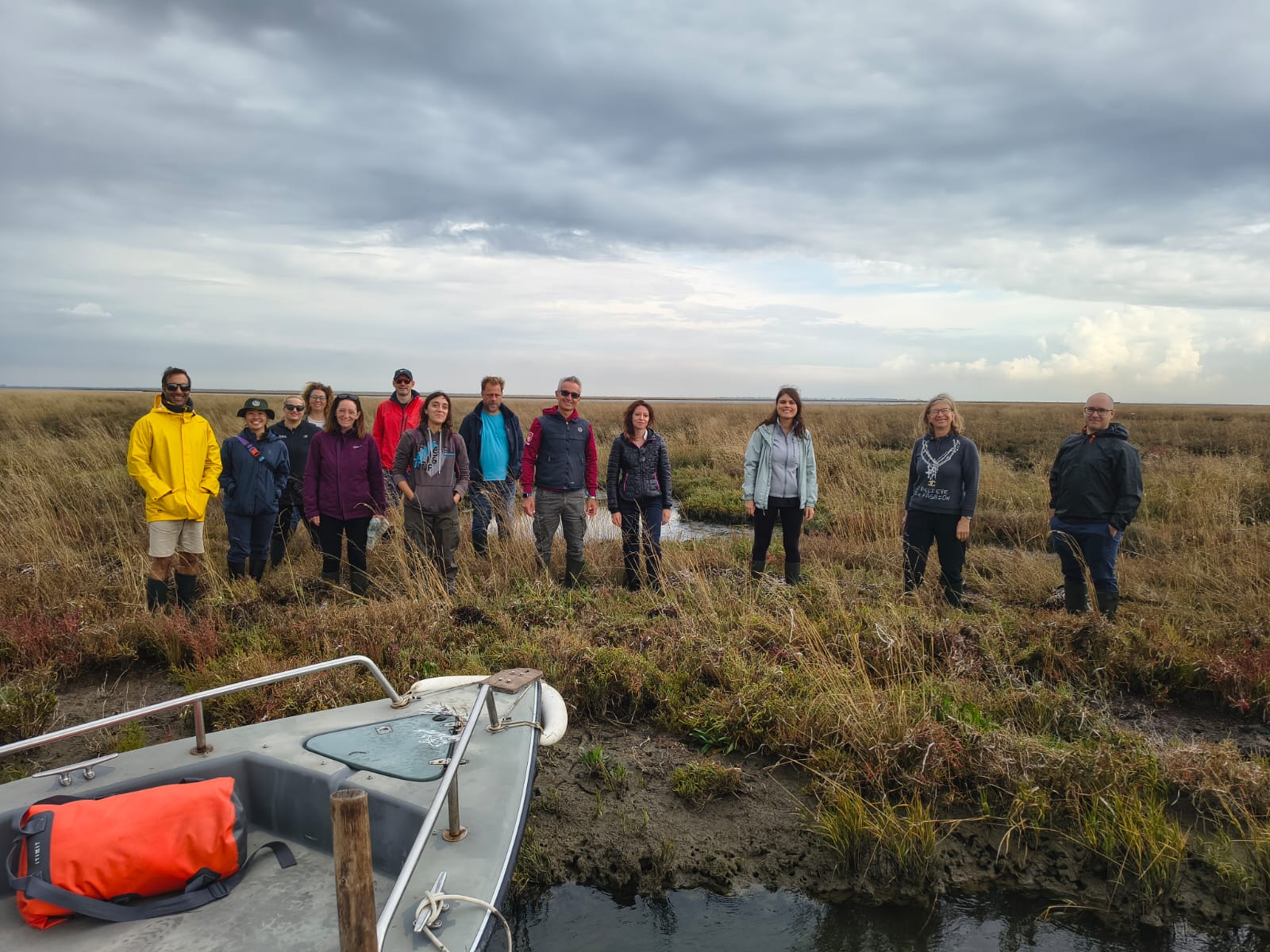
BLUESHORES project team selecting implementation areas
The European BLUESHORES project is a response to the need to protect the structural and functional integrity of urban coastal areas and their natural resilience to disturbances.
The Institute of Environmental Hydraulics of the University of Cantabria (IHCantabria) participates in the kick-off meeting of the BLUESHORES project, approved under the Sustainable Blue Economy Partnership call, co-funded by the European Union.
Many coastal areas around the world are protected by conventional infrastructure such as sea walls, breakwaters or sea walls, which have a negative impact on the natural environment, are increasingly costly, and cause significant greenhouse gas emissions.
The adoption of hybrid solutions for coastal protection is limited due to a lack of design criteria, performance indicators, and a lack of rigorous evaluation of their life-cycle impact and return on investment.
The objective of the BLUESHORES project is to produce and test new hybrid solutions for the protection of coastal areas in cities. These solutions will be cost-effectively adapted to local conditions, to provide infrastructures that dissipate flow energy to control erosion of the edges of the protective ecosystems of the area; favor the recovery of local species; and create an aesthetically pleasing environment that enhances the coastal landscape, harmonizing it with the cultural landscape and facilitating its social use.
To this end, they will design and test the new solutions in three study areas (the Venice lagoon in Italy, the Scheldt estuary in the Netherlands, and Cork harbor in Ireland). They will use quality standards and indicators to assess their technical, biogeomorphological, ecological and social impact, and will develop efficient and accurate models and tools to characterize the energy attenuation capacity of the flow produced by the solutions under various environmental conditions. Costs and multiple benefits throughout the life cycle of the solution will also be evaluated, and barriers and opportunities for scaling up these designs and applying them to other parts of the world will be identified.
To ensure the success of the project, considering the socio-economic context of each implementation site, co-creation and co-design of the solutions will be carried out with the participation of all relevant actors (industry, policy makers, researchers and stakeholders).
The representatives of IHCantabria in this project, the principal investigator María Maza, and the European project manager Patricia Bueno, have participated in the first meeting of the consortium, held in Venice. IHCantabria will lead the numerical modeling work package, and will actively collaborate in the field campaigns and participatory processes.
BLUESHORES project results (36 months):
- Advanced models to optimize the design and implementation of new hybrid solutions in different environmental settings.
- Evaluation framework with standardized metrics and methods to simultaneously assess the technical, environmental and social performance of the solution.
- Complete economic evaluation of solutions to facilitate future business opportunities.
- Guidelines to support decision-makers and industry in the design and implementation of these solutions at other sites, based on the local environmental and social context.

Partners: University of Padua, IT (coordinator), IHCantabria, the Netherlands Institute for Sea Research; National Institute for Aquatic Resources, Technical University of DenmarK; University College Cork, Athenarc, Provveditorato interregionale per le Opere pubbliche Veneto- Trentino Alto Adige – Friuli Venezia
This project is co-financed by: