IHCantabria culminates the Cop.RIVER project on monitoring fluvial landscapes with remote sensing
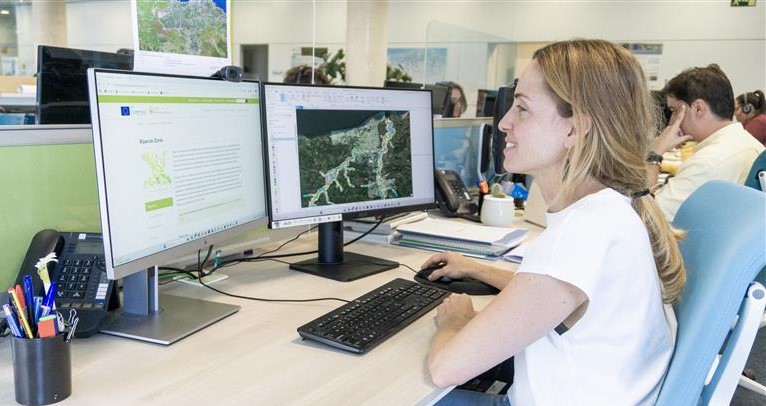
Laura Concostrina, Ramón y Cajal researcher and Cop.RIVER project PI
The development of this project has made it possible to identify key indicators for assessing the conservation of rivers and riparian forests with tools from the European COPERNICUS program
The Environmental Hydraulics Institute of the Universidad de Cantabria (IHCantabria) has concluded this week the development of the Cop.RIVER project, which has analyzed the usefulness of Earth observation data from the European program COPERNICUS, to improve the monitoring of river ecosystems and their banks. Its execution period has been from 2022 to 2025.
This project ended with the organization of an expert workshop entitled “Needs and methodologies for water and sediment characterization in river ecosystems”, which took place online on September 23. On the following day, a user uptake session of the COPERNICUS products of the CLMS was held, which has proved to be of great interest for the assessment and monitoring of river ecosystems.
The expert workshop was attended by various agents ─such as the Directorate General of Water, the Catalan Water Agency, the Cartographic and Geological Institute of Catalonia (ICGC) and the company Aquacorp S.L.─ with whose representatives information was exchanged on the challenges faced by the administration and environmental managers when assessing and monitoring the attributes and processes associated with the aquatic and sediment component of the river, as well as possible technical solutions, taking into account the main results of the Cop.RIVER project. This workshop was also attended by participants from the field of administration and management of river landscapes (TRAGSA group and Fundación Biodiversidad, among others), as well as scientists and companies related to the use of remote sensing(Zenithal Blue Technologies S.L.U.).
In the user uptake session, held on September 24, CLMS products that contribute to the characterization of elements and phenomena associated with floodplains and riparian vegetation formations were presented. Based on the experience gained with the development of the Cop.RIVER project, the potential and limitations of CLMS products were analyzed and a practical demonstration of how to obtain and process these products was given. The audience that participated in this session ranged from administration technicians to PhD students and researchers from Portugal, Germany and Italy.
Indicators for improving water and biodiversity management
The work has allowed the selection of a set of terrestrial and aquatic indicators, based on the use of remote sensing, that facilitate the monitoring of the conservation status of rivers, riparian forests and floodplains. In addition, the applicability of COPERNICUS products -such as satellite images, vegetation indices or thematic cartographies (such as Riparian Zones)- has been evaluated and a methodology combining these data with proprietary tools, developed within the framework of the project, has been proposed. The application of this methodology allows the spatial scope of the information to be expanded, increases the number of fluvial landscape components that can be evaluated and improves the taxonomic characterization of riparian formations.
These advances provide valuable scientific and technical support for implementing environmental policies ─such as the Habitats Directive, the Water Framework Directive or the European Biodiversity Strategy 2030─ which will contribute to the design of more effective restoration and conservation strategies.
In the words of the principal investigator (PI) of this project, Laura Concostrina Zubiri, “Cop.RIVER has allowed the pooling of interests and challenges, by environmental agencies, and of technical and methodological capabilities, by the scientific community in the field of the evaluation and monitoring of attributes, processes and functions of fluvial landscapes, using remote sensing”. This is explained by Laura Concostrina Zubiri, Ramón y Cajal researcher who has developed this project at IHCantabria during the last three years, together with José (Pepe) Barquín and Fernando Rodríguez Montoya.
Collaboration with administrations and key players
The Cop.RIVER project has been characterized by a constant dialogue with the institutions responsible for water and biodiversity management, such as the Directorate General for Water, the Directorate General for Forestry and Biodiversity, the Cantabrian Hydrographic Confederation, botanical experts from the Autonomous University of Madrid and the University of Valencia, and the Tragsa Group, among others. Through thematic meetings and workshops, these actors have presented their needs and experience, and have had access to information on new methodologies based on remote sensing.
Cop.RIVER has also contributed with concrete applications of COPERNICUS products in two case studies: the Saja-Besaya basin and the Pas basin, examples that illustrate how remote sensing can support the integrated management of river landscapes.
Scientific and social dissemination
The results of the project have already been shared in congresses, specialized journals and through an interactive guide that will be available on the project’s website, which contributes both to scientific progress and to the transfer of knowledge to the public administration and society.
With the successful completion of Cop.RIVER, IHCantabria reinforces its role as an international reference center in the study and sustainable management of aquatic ecosystems.
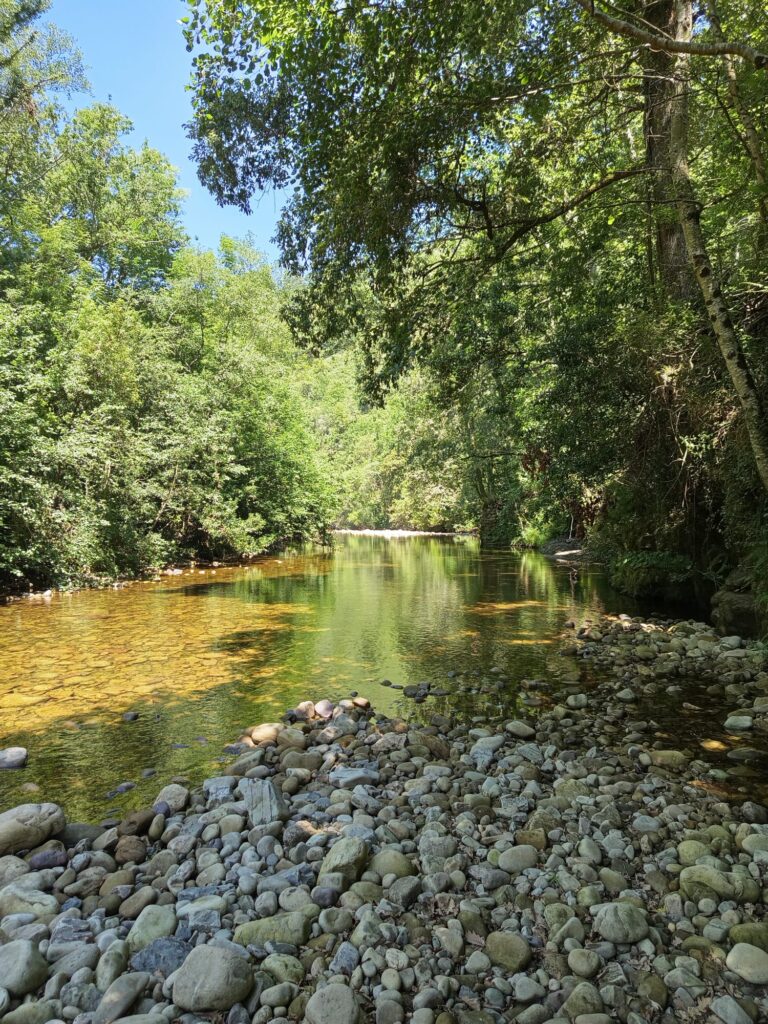
Pas river, near the town of Vega de Pas, in Cantabria, Spain
This project is implemented with funding from: