IHCantabria reinforces its leadership in climate risk analysis at the conference on engineering for extreme events
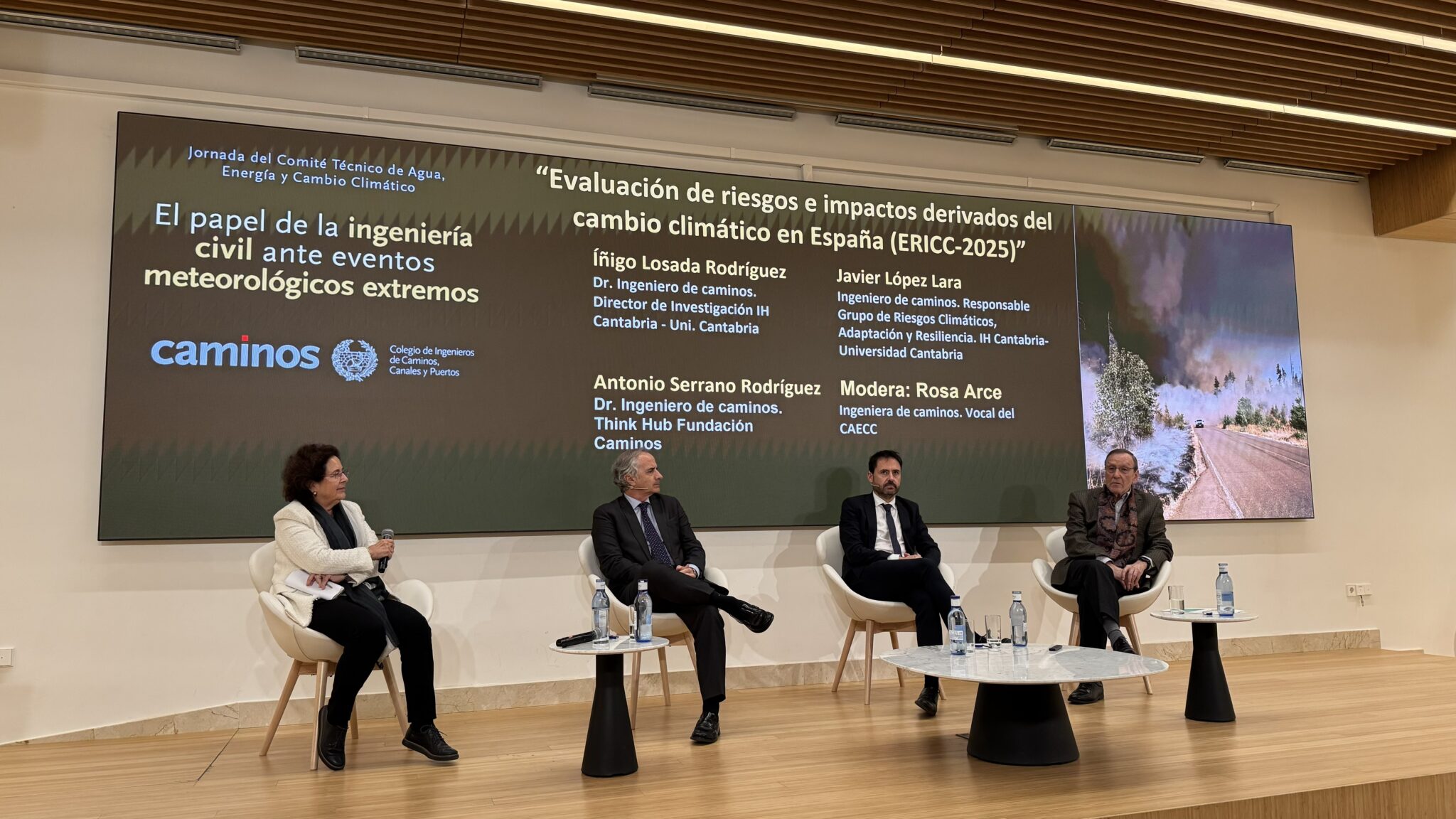
IHCantabria addresses the role of civil engineering facing extreme weather events and stresses the need to move towards engineering approaches based on probabilistic risk analysis, uncertainty management, systemic and sectoral analysis, considering their interdependencies, especially in complex environments such as coastal and urban areas where high vulnerability is concentrated
The Environmental Hydraulics Institute of the Universidad de Cantabria (IHCantabria) participated in the conference “The role of civil engineering facing extreme weather events”, organized on March 23 by the Technical Committee on Water, Energy and Climate Change of the Association of Civil Engineers in Madrid. The meeting brought together institutional leaders, scientific experts and professionals from the sector to address the challenges posed by climate change on infrastructures, the territory and society.
At the round table dedicated to the assessment of risks and impacts derived from climate change in Spain (ERICC-2025), Íñigo Losada, Research Director of IHCantabria, and Javier López Lara, head of the Climate Risks, Adaptation and Resilience group, presented the main advances and results of the project.
The ERICC-2025 is the first comprehensive analysis on a national scale aimed at identifying, characterizing and prioritizing climate risks in Spain, with the objective of supporting adaptation planning. The study, coordinated by the Ministry for Ecological Transition through the Spanish Office for Climate Change (OECC), and developed by a consortium led by IHCantabria together with Tecnalia Research & Innovation and the Basque Centre for Climate Change (BC3), is based on the synthesis of the best available scientific evidence, integrating knowledge from multiple disciplines and sources.
Among its main findings, the ERICC identifies 141 relevant climate risks affecting natural, economic and social systems, of which 51 are considered key due to their severity or urgency. In addition, the analysis reveals the existence of more than 1,700 interrelationships between risks, demonstrating that climate change impacts do not act in isolation, but generate cascading effects that can amplify their consequences. This systemic approach is one of the most relevant advances of the study and reinforces the need to adopt integrated adaptation strategies in order to ensure their effectiveness and avoid maladaptation.
Based on the results of the ERICC-2025, Íñigo Losada highlighted how the intensification of extreme phenomena (such as floods, droughts, coastal storms or fires) is substantially modifying the levels of risk on infrastructures and territories. He also highlighted the role of engineering as a key element in translating scientific knowledge into applicable solutions, stressing the importance of integrating climate risk assessment into the design, planning and management of infrastructures. In this regard, he stressed the need to incorporate resilience criteria from early planning stages, as well as to improve the capacity to anticipate extreme events, always from a systemic point of view.
Javier López Lara pointed out that the ERICC constitutes a key basis for the development of the next National Climate Change Adaptation Plan, reinforcing the integration of adaptation into sectoral and territorial policies, and contributing to improving the country’s preparedness to face the impacts of climate change. He explained how the results of the study make it possible to establish priorities for action based on scientific evidence, facilitating the identification of critical risks and the efficient allocation of resources. In particular, he stressed the importance of incorporating quantitative risk and resilience metrics into decision-making processes, as well as considering cascading effects and interdependencies between sectors. He also stressed the need to develop tools to transfer this knowledge to territorial planning, infrastructure management and public and private investment, in line with European regulatory frameworks.
IHCantabria’s participation in this conference reinforces its position as an international benchmark in the analysis of climate risks and infrastructure resilience. Through its leadership in the ERICC-2025, the institute contributes decisively to the advancement of knowledge and the development of tools to anticipate, quantify and manage the risks associated with climate change, facilitating the transition to safer, more resilient and sustainable territories.